
8 Important Pre-Marriage Counseling Questions
🎧 Listen to this article
As you approach engagement or if you are newly engaged, it is important to the start of a thriving and successful marriage to take time to learn more about your significant other. This often means having difficult conversations, talking about the future, and digging deeper into your past to discover how it made you into who you are today and where you hope to go.
 It is better to have important and life-shaping conversations before you vow to spend your lives together. These conversations can help you discover any red flags or draw you closer to one another as you prepare to spend your lives together, for richer and poorer, in sickness and in health. Newport Beach Christian Counseling offers guidance to help couples navigate these crucial discussions with wisdom and faith.
Having important conversations before you wed can help you set realistic expectations for your marriage, improve your communication skills, and strive to improve your conflict-resolution skills before you face any major relationship challenges and barriers.
Greg Smalley said, “Make it your goal to create a marriage that feels like the safest place on earth.” The goal of marriage is not to appear perfect all the time, the goal is to create a safe place for pure authenticity between two people.
Pre-Marriage Counseling Questions to Ask Before You Say “I Do”
Here are a few questions to delve into with your significant other as you prepare to say “I do”:
1. What does a marriage commitment mean to you?
 It is important to talk through commitment and what it means to each of you. Once you walk down the aisle and vow to spend your lives together, does that mean through thick and thin? Does that mean you vow to keep working even when you feel disconnected and distant from one another? What does that mean when one of you gets a job offer in a different place? Take time to talk through marriage commitment and why you were drawn to your significant other.
Henry Ward Beecher said, “Every successful marriage is the result of two people working diligently and skillfully to cultivate their love.” Spoiler alert: marriages face difficult seasons, therefore having these conversations and vowing to put the work into your marriage will help it grow and thrive on a beautiful level.
2. What are your life goals?
You must talk through your life goals, not only so your spouse can support you, but so that you can support them. Ask one another about your personal goals, career goals, and spiritual goals. What dreams do you have for your marriage? Do you hope to retire to the Arizona desert and start a nonprofit one day? Dreaming big together can draw you closer and help you support one another now and in the future.
3. What is your financial plan?
The battle with finances and how to handle finances is one of the major causes of fighting and disagreements in marriage. Engaged and married couples must continue to have financial conversations and plan together. Sit down and create a financial plan. Put your expenses on paper. See if you need to cut any expenses so you are not living hand-to-mouth.
Take time to talk through the plan for handling money:
- Will you have separate bank accounts, joint checking accounts, or both?
- Who will pay the bills?
- How will you handle disagreements about how money should be spent?
- Do you plan and agree to have full financial disclosure with your spouse?
- What kind of debt are you going into marriage with?
- Do you have or plan to have credit cards?
- What is your credit score goal and how can you work together to get there?
- Will you have an emergency savings fund?
- Do you plan to start saving for a home or another major first purchase together?
- Do you plan to start savings accounts for your children?
4. What is your plan for living arrangements?
If you both have your own place right now, what is your plan once you are married? Where do you hope to live once you begin having children? Talking through your plans can help alleviate stress and begin your journey in the best way possible. Establishing healthy communication is one of the best things you can do for your marriage relationship.
5. What are your desires for growing your family?
 Some couples wait until years into their marriage to talk about their hopes and dreams for a family. To avoid miscommunication in the future, it is helpful to just talk through what you pray for someday. Do you hope to have children? Are you wanting a big family or a small family?
Have you had an abortion in the past that you have not discussed with your significant other? Do you hope to raise your child in church? What are your hopes and dreams for your family? Do you hope mom stays home with the children or do you hope to continue working?
How did your childhood impact your hopes and dreams of having a family? If you were raised in an abusive home and previously felt reluctant to tell your significant other, now is the time. If there were parts of your childhood and upbringing that made you into the person you are today and hope the same for your family, share those memories and dreams.
6. What are your mutual expectations?
Talking through various parts of your life and relationship can help avoid major disagreements and fallout in the future. Just talking through mutual expectations for your marriage can help cut those disagreements and frustrations in half. It is crucial to know that couples will have disagreements. Marriage is a game of working together to find common ground.
- Will you spend holidays rotating between both sides of your family?
- How will you support one another through chaotic work seasons?
- What are your hopes for physical intimacy?
- Do you hope to attend church together?
- What kind of relationship do you hope your children have with your parents?
- How will you continue dating one another?
- Do you hope to continue date night once a week?
- Do you agree on time with friends – separately and together?
“Behind every great relationship are difficult and uncomfortable conversations we rarely get to see. Great relationships don’t just fall into our laps. They require people to move through their fears and insecurities and do the hard work to move wounds into healing.” – Vienna Pharaon
7. How will you resolve conflicts?
Having a plan for resolving conflict is one that every relationship can benefit from. If you are having a conversation that continues to escalate, how can you manage it before it spins out of control? Can you ask each other for a timeout to calm down and take a deep breath? Are you willing to get creative with your critical thinking skills?
8. What does your spiritual life mean to you and for your marriage?
I pray that your love for each other will overflow more and more and that you will keep on growing in your knowledge and understanding. – Philippians 1:9

To marry someone of like faith is the beginning of a beautiful and one-of-a-kind love story. Marriage, God’s way, is a marriage of forgiveness, grace, compassion, and unique and selfless love. As you begin to embark on your journey together, take time to set goals, pray for your significant other, pray as a couple, and let your faith live larger and louder than your fear.
It is important to realize before you say “I do” that marriage is a journey, not a destination. You will face difficulties. You will have disagreements. You will make up and work through disagreements. You will have seasons of disconnect. You will have seasons of beautiful and one-of-a-kind connection. Marriage is a beautiful ride and one that is worth the difficult conversations.
Christian Premarital Counseling
As you prepare for marriage, consider pre-marriage counseling to help work through these topics and to help you set realistic expectations for your marriage, improve your communication skills, and strive to improve your conflict-resolution skills before you face any major relationship challenges and barriers. You can invest in the future of your marriage by attending pre-marital counseling with a counselor at Newport Beach Christian Counseling who wants to see your relationship soar.
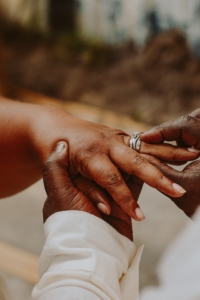
“Holding Pinkies”, Courtesy of Jasmine Wallace Carter, Pexels.com, CC0 License; “Save the Date”, Courtesy of Olya Kobruseva, Pexels.com, CC0 License; “Surprise Proposal”, Courtesy of Radu Florin, Pexels.com, CC0 License; “Forehead Kiss”, Courtesy of Jonathan Borba, Pexels.com, CC0 License
 We delight to connect with others, to know and be known and loved by others. In our relationships, we make ourselves vulnerable, build networks of mutual dependence, and build parts of our lives based on those relationships.
  Part of trying to address a broken relationship is to understand why it broke down in the first place and to do the challenging work that may be needed to change. It may be that in trying to understand what happened, you may uncover a misunderstanding and that gets things back on track.
 In other words, it can get complicated, but being willing to examine ourselves and apologize may be a necessary precursor to reestablishing the relationship. This doesn’t mean backtracking and dismissing what was said but acknowledging the pain that may have been caused or boundaries traversed.
 When a relationship is broken, both parties may agree that things went wrong, and that the situation needs to be resolved. When things go awry in a relationship, the sense of trust and vulnerability may be broken, and you become a bit more wary of one another. A relationship, even one that the people in it are willing to work at, doesn’t just snap back to what it was before the issue arose.
 When God created us, we were fashioned in God’s image: “So God created man in his own image, in the image of God he created him; male and female he created them” (Genesis 1:27). God, who is eternally Father, Son, and Holy Spirit, is deeply and inextricably relational.
 Reflecting on marriage while writing to the Christians in Ephesus, the apostle Paul recalls what was said in Genesis 2 and reminds them that when two people get married, something monumental takes place – the two become one flesh. But then he drops the bombshell that human marriage is an echo of the relationship that Jesus has with his people. This is a “profound mystery”, he writes (Ephesians 5:32).
 This was written before the advent of the electric blanket, but the point is well-taken. Having someone to share life and a bed with is pleasant. Many married couples can attest to the joy of having someone to pre-warm the bed and snuggle up to, and how the input of their partner has helped them to make a better life and business decisions.
 The birth of children can change our priorities; the loss of a job can drastically change how you perceive yourself; meeting new people or reading new books can shift our views on politics or other areas of life. In all this, rather than growing apart, a couple can share in one another’s journey so they grow together.
 The honeymoon period might mean constant togetherness, a high of physical intimacy, and make you wonder if your spouse could ever do wrong in your eyes. There might be a literal hormonal spike as you get married and experience the wedded bliss of waking up to the love of your life, spending every night together, and getting to be with them in the mundane moments.
 You vowed to love one another through sickness and in health. For richer or for poorer. For better and for worse. You vowed to love one another when you wake up with morning breath, when one of you does not replenish the toilet paper in the bathroom, when you disagree over which side of the family you should visit at Christmas, and how to handle the order of priority in your finances. Marriage is working through disagreements, not running at the first sight of them.
 Once the honeymoon period comes to a halt, raw and vulnerable conversations need to be at the forefront of your marriage. To continue thriving in your relationship, you cannot stay dormant. You must keep looking forward, even when you are unsure of what forward looks like.
 If you want your marriage to thrive, the secret ingredient is not how lavish your lifestyle is or whether he brings you fresh flowers every week. Marriage should be centered on a relationship with Christ, focusing on the qualities of Christ.
 Recall your wedding day. Remember both of you standing on the altar and looking into his eyes as he was saying to you that he would be faithful and loving until the day he dies. I am sure at this moment you don’t feel that at all and that is okay. This article is not to persuade you about your valid emotions.
 Secondly, your husband needs you to be his greatest support. God is there with you all. The human being that needs him now more than ever is you. You have been an outstanding wife. You are a great mom, you cook and clean, you help pay the bills and do the dirty work around the home. You have grown in sexual intimacy with your husband and given him your best. You didn’t deserve this – you deserve better!
 At first, it may start as an innocent crush or curiosity. Later, however, it develops into a relentless cycle of addiction that leaves them hopeless. Men need to be built up and encouraged for them to feel safe enough to be open. I encourage any reader to ask that question to see how your husband would respond. He may cry or he may get angry but that’s the point. He is feeling stuff and not dealing with it.
 Over time, he may give in and be curious about getting help. This step empowers you, but it also frees you from being a victim. You are not a victim! I will say it again, you are not a victim! You are a noble woman of God who is experiencing what many other women have or are currently experiencing in their lives.
 God has not left us alone in this. The Bible gives us wisdom on how to navigate this important area of life, challenging and encouraging us to enter and conduct relationships in a healthy manner. Below are a few key verses with wisdom on handling and thinking about relationships in a life-giving way.
 knows God. Whoever does not love does not know God, because God is love… If anyone says, “I love God,” yet hates his brother, he is a liar. For anyone who does not love his brother, whom he has seen, cannot love God, whom he has not seen.” (1 John 4:7-8, 20).
 The earlier verse mentioned getting rid of anger. Anger is a real issue for many. While anger is a valid emotional reaction to circumstances or certain actions by people, it can become crippling if we live in it. Anger can fester and take root so deep that even being in the same room with the person becomes impossible.
 God has placed us in many different communities, including the community of faith. To live out the Christian life, we need that community. The reciprocal pronoun “one another” is prominent in the New Testament: “Live in harmony with one another” (Romans 12:16); “Be servants of one another’ (Galatians 5:13); “Comfort one another” (1 Thess. 5:11); “Submit to one another” (Eph. 5:21); “Forgive one another” (Col. 3:13); “Confess your sins to one another” (James 5:16); “Love one another from the heart” (1 Pet. 1:22) and so many more.
 Adam and Eve had one another in this brave new world – someone who was an equal but different and complementary. Since people are made in God’s image, it makes sense that Adam and Eve had an innate desire for relationship and that it wouldn’t be good for either of them to be alone. As descendants of Adam and Eve, all of us are the result of this first marriage.
 Of all the things one could say about marriage, one apt description is that it is a mystery. It’s a mystery in a least two ways. First, despite our culture’s fractious relationship with marriage, the vast majority of people are still drawn towards making the public and lifelong commitment that is marriage.
 In other words, if you want to get married, that’s great, but marriage comes with certain responsibilities or anxieties, and you must be aware of that. If you want to stay single, that’s also great. The single life enables a certain kind of unbroken focus on the kingdom. In other words, the calling toward either marriage or singleness is morally neutral; each life comes with its own joys and burdens.
 It also addresses the harmful attitudes of others who are not in the marriage and who don’t take the marriage covenant seriously. The letter to the Hebrews says, “Marriage should be honored by all, and the marriage bed kept pure, for God will judge the adulterer and the sexually immoral” (Hebrews 13:4).

 This is a way to show respect for your spouse. Be willing to listen. “Be slow to speak, quick to listen, and slow to become angry.” Listen to their words and listen to the things they do that speak louder than words. Listen to what they feel and what they think. Listen to their body cues and body language. Listen to their health and their other relationships. If you notice that your spouse is struggling or needs you to step in and love them better, it is your job to do that.
 Physical Touch: Some people feel most loved with hugs, cuddles, massages, kisses, or sexual activity. Touch your spouse! Your sexual health in your relationship is vital to the overall health of your relationship.
 The pandemic has brought many issues to the surface, such as depression due to constant isolation and anxiety when alone. Autophobia is the fear of being alone and is especially difficult the older you are. Undoubtedly, families and couples did better than singles while being left alone for such a long time during the pandemic.
  Sadly, many couples also ended their relationship in 2020 because the pandemic tested them beyond their capabilities and forced them to tap out. Couples’ characters were exposed and with the added pressures of isolation, they had no one to turn to. These marriages had little to no support that otherwise could have been of immense help.
 This is an interesting passage for couples because if my partner and I are one then who is going to help our one unit? Some may suggest that spouses are the other individual to help them out, but we can challenge that position by reminding everyone of the goal that God designed in Genesis 2:24 “the two will become one.”
 Having a healthy dynamic marriage is priceless. I look back to when Nicole and I got premarital counseling and I shudder to think what would be said of us right now if we had never invested in our relationship after our engagement. In truth, our marriage would be a nightmare.
 Think about the following: fame, fortune, popularity, success, power, family, and so forth. Why do we want all these things? We want them because we want to be loved. Maybe we won’t admit it but at the end of the day, we work hard because we are searching for that endless love. There are some interesting proverbs in the Bible that support this.
 Another possibility is that maybe you or someone who is in an emotional affair and you’re wondering if you’ve gone too far. This article interested you because you are at a crossroads in your relationship, and you may have ventured out of the boundaries in an emotional relationship and now you are contemplating on what you are going to do.
 Adultery doesn’t just happen, it evolves, and these scriptures point out that it started within us. It could be why in the gospel it says that the most important commandment is to love our Lord with all our Heart, Soul, Mind, and Strength. God wants all of us. He doesn’t accept partial love.
 This approach is excellent for those who have been hurt by emotional infidelity because they feel the pain of being betrayed. They can explore those feelings and realize past trauma tied into the current hurt. The process continues as to what they are thinking and possible actions they can take to empower themselves. This is one of many possible approaches but in my work with hundreds of clients, I can’t think of a better approach.